Biblical Inerrancy: The Historical Evidence by Norman Geisler
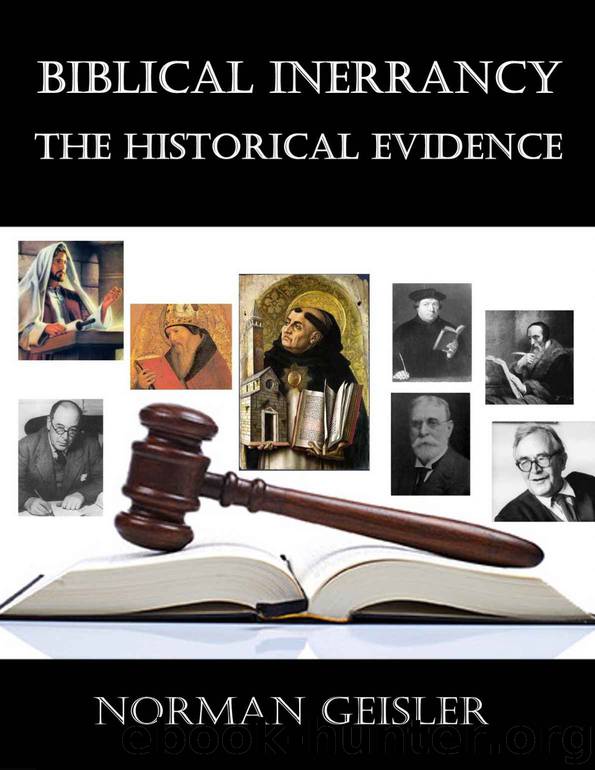
Author:Norman Geisler [Geisler, Norman]
Language: eng
Format: azw3
Publisher: Bastion Books
Published: 2013-11-03T04:00:00+00:00
E. Progressive Truth of the Bible
1. Cosmology
It all was made in six days, each with a morning and an evening, a short and measurable time before. This is the world-view of the Bible. . . . Moreover, it remained the world-view of the Christian church for a long time. Augustine, with uncompromising strictness, stated the authority of Scripture in matters such as this: “Scripture, which proves the truth of its historical statements by the accomplishment of its prophecies, gives no false information.” Those early fathers have been severely handled because they thus clung to a world-view which might have been outgrown long before it was, had not their literalism barred the way. In this insistence upon an old cosmology, however, they were but children of their age (Modern Use, p. 47).
Even Luther called Copernicus a fool for suggesting that the earth moved, and roundly capped his argument by calling to witness the Scripture which says that Joshua made the sun stand still and not the earth (Ibid., p. 50).
2. Inspiration
Our ideas of the method of inspiration have changed; verbal dictation, inerrant manuscripts, uniformity of doctrine between 1000 B.C. and 70 A.D.—all such ideas have become incredible in the face of the facts (Ibid., p. 30-31).
The first results of critical research into the Bible seemed disruptive, tearing the once unified Book into many disparate and often contradictory documents. The final result has turned out to be constructive, putting the Bible together again, not indeed on the old basis of a level, infallible inspiration, but on the factually demonstrable basis of a coherent development (Guide to Understanding, p. ix).
3. Miracles
Multitudes of people, so far from being well-stabilized traditionalists, are all at sea in their religious thinking. If ever they were drilled in older uses of the Bible they have rebelled against them. Get back to the nub of their difficulty and you find it in Biblical categories which they no longer believe—miracles, demons, fiat creation, apocalyptic hopes, eternal hell, or ethical conscience (Modern Use, p. 5).
4. Morality
The Old Testament exhibits many attitudes indulged in by men and ascribed to God which represents early stages in a great development, and it is alike intellectually ruinous and morally debilitating to endeavor to harmonize those early ideals with the revelations of the great prophets and the Gospels. Rather, the method of Jesus is obviously applicable: “It was said to them of old time . . . but I say unto you” (Ibid., p. 27).
5. Theology
It is impossible that a Book written two to three thousand years ago should be used in the twentieth century A.D. without having some of its forms of thought and speech translated into modern categories. When, therefore, a man says, I believe in the immortality of the soul but not in the resurrection of the flesh, I believe in the victory of God on earth but not in the physical return of Jesus, I believe in the reality of sin and evil but not in the visitation of demons, I believe
Download
This site does not store any files on its server. We only index and link to content provided by other sites. Please contact the content providers to delete copyright contents if any and email us, we'll remove relevant links or contents immediately.
The Five People You Meet in Heaven by Mitch Albom(3550)
The Secret Power of Speaking God's Word by Joyce Meyer(3161)
Real Sex by Lauren F. Winner(3005)
Name Book, The: Over 10,000 Names--Their Meanings, Origins, and Spiritual Significance by Astoria Dorothy(2969)
The Holy Spirit by Billy Graham(2938)
0041152001443424520 .pdf by Unknown(2842)
How The Mind Works by Steven Pinker(2811)
ESV Study Bible by Crossway(2772)
Ancient Worlds by Michael Scott(2678)
Churchill by Paul Johnson(2576)
The Meaning of the Library by unknow(2563)
The ESV Study Bible by Crossway Bibles(2546)
The Gnostic Gospels by Pagels Elaine(2517)
MOSES THE EGYPTIAN by Jan Assmann(2411)
Jesus by Paul Johnson(2349)
City of Stairs by Robert Jackson Bennett(2337)
The Complete Dead Sea Scrolls in English (7th Edition) (Penguin Classics) by Geza Vermes(2269)
The Nativity by Geza Vermes(2224)
Ancient Near Eastern Thought and the Old Testament by John H. Walton(2220)
